Highlighting Lesser Known Explorers
William Pugh Duncan
The year 2026 is the 250th anniversary of the founding of the United States in 1776: the semiquincentennial. There are many events planned across the country, most of them around the date of the Declaration of Independence on July 4th. My co-author Dr. MacCutcheon and I thought that an activity that continued throughout the year would help people remain in a patriotic mood for this important milestone for our country. One thing that makes the United States different from other nations is that the land was the way that discovery and exploration tied into the development of the country. So we have prepared a guided journal for the 250th year. There is a page for each day, and each page has a quote from an explorer or pioneer from our history. Most pages also have a brief discussion or meditation on the quote – this may be about the explorer, their times, and their history; or it may be a discussion about the applicability of the quote to life in general. Finally, a few lines are usually provided for each journaler’s own thoughts. A handful of quoted passages are longer and fill up the page!
Purchase on Amazon: https://www.amazon.com/Discovering-America-Again-Quotations-Explorers/dp/B0GCZ7RCDB/
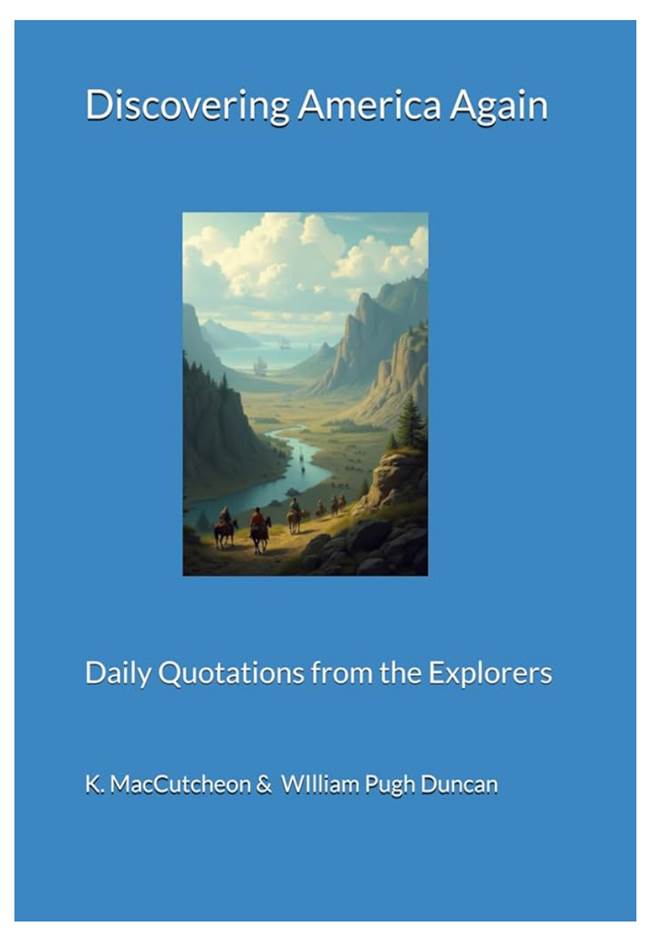
The explorers and pioneers quoted in the journal range from Columbus through Lewis and Clark to Neil Armstrong. Along with such well known figures, we have also found quotes from many less celebrated explorers. This array of nearly forgotten actors demonstrates the many different threads that have woven together the American tapestry. Many readers will learn a lot, and even those most familiar with American history will be reminded of the everyday heroes who built this country. In this brief article, we will share a few of these lesser known stories.
Here is the page for January 12, featuring the Spanish explorer Alvar Nunez Cabeza de Vaca:
Alvar Nunez Cabeza de Vaca
“If one lives where all suffer and starve, one acts on one’s own impulse to help. But where plenty abounds, we surrender our generosity, believing that our country replaces us each and several. This is not so, and indeed a delusion. On the contrary the power of maintaining life in others, lives within each of us, and from each of us does it recede when unused. It is a concentrated power. If you are not acquainted with it, your Majesty can have no inkling of what it is like, what it portends, or the ways in which it slips from one.”
Alvar Nunez Cabeza de Vaca was a tremendous explorer who is relatively unknown. He was the first European to visit (by land or sea) six states: Alabama, Mississippi, Louisiana, Texas, New Mexico and Arizona. In 1527, Cabeza de Vaca was King’s representative on an expedition to the lands west of Florida. The leader made many poor decisions, and Cabeza de Vaca was one of four survivors. By ship, on horseback, on foot, and finally by jury-rigged raft, the explorers traveled from Cuba to Florida, then west, through or along the Gulf Coast. Caught in a storm in the Gulf of America, they were shipwrecked near Galveston. The survivors were enslaved by the Native Americans of the Gulf Coast for several years, until four managed to escape. These four wandered into the interior of modern Texas and the Southwest. Cabeza de Vaca lived with different tribes and acted as a trader and a healer, eventually reaching the Gulf of California. They then made their way back inland, and reached the lands where the Spanish had recently conquered the Aztecs and other tribes, returning to Spain after 8 years of travel through the Americas. Cabeza de Vaca returned as Governor of a territory in modern Argentina. His years of living with the Native Americans made him sympathetic to them, which eventually lost him this post. He published the story of his travels in 1542 – English translations exist.
This first quote from Cabeza de Vaca is powerful. Years of suffering through his travels, often near death from starvation, made him see the necessity of personal action to help others. How often do we think that “our country replaces us” in the need to help the less fortunate? As we ourselves are on our voyages of exploration – even when we are shipwrecked and starving – let us remember and act on the impulse to help.
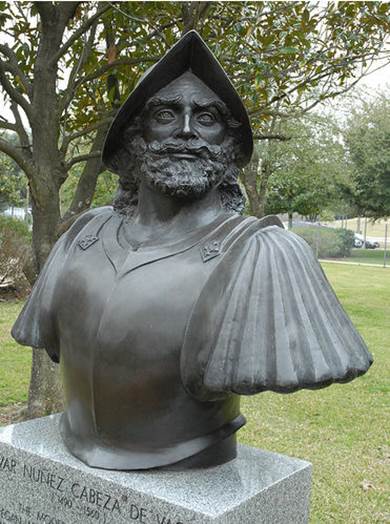
Bronze bust of Cabeza de Vaca in Houston, TX.
There are a few other quotes from Cabeza de Vaca on the pages for the next few days following January 12th – since we explain his history on this first page, discussions of his words are shorter on these following pages. This is the general format – if it is a new person being quoted, we provide the historical context, then there is the brief discussion. If we quote someone over several pages, the history is only provided once.
Here is the page for February 20, featuring Bill Pickett. February is African-American History month, so there are African American quotations provided out of the chronological sequence that is generally followed. So Bill Pickett is from the late 19th and early 20th century, but is quoted in February mixed in with quotes from the 17th and 18th centuries.
Bill Pickett
“What’s gonna happen, gonna happen”
Bill Pickett was a cowboy who developed the technique of “bulldogging”. This was incorporated into rodeo events, and developed into modern steer wrestling. Bulldogging consists of wrestling a steer to the ground by the horns. As you can imagine, it is pretty risky! Of both African-American and Native American ancestry, Pickett was born in 1870, worked as a cowboy, and travelled with rodeos, demonstrating his skills. He appeared in a few early cowboy films in the 1920’s. He died after being kicked in the head by a bronco in 1932.
Today’s quote from Pickett is the proper attitude for someone who performs a dangerous stunt repeatedly. After you have prepared as much as possible, do your best and let events fall where they may. This is good advice for all of us – “paralysis by analysis” never leads to success.
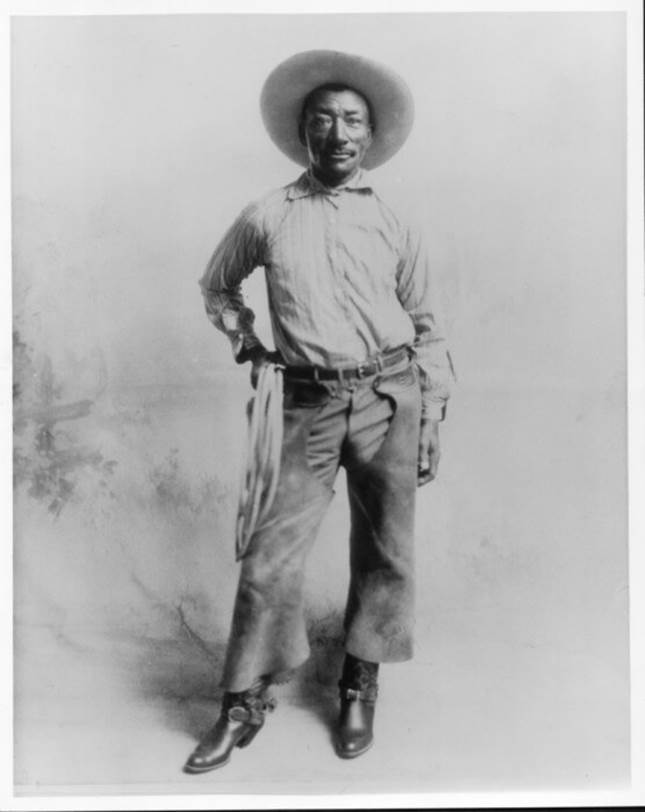
Bill Pickett, about 1907.
There are 366 quotes in the book – we included a page for February 29th in case someone decides to journal in a leap year! Along with African-American History month, we have special emphasis for Women’s History month in March, Inventor’s month in May, Space Week in October (featuring astronauts), and Native American history month in November. The quotes otherwise trend chronologically throughout the year. It isn’t strictly necessary to start on January 1, however! You can start anywhere in the year, or start at the beginning on some other date – you can read it cover to cover at one sitting if you like! You will hear from mariners, soldiers, surveyors, fur traders, pioneers, and more: survivors like Virginia Reed; those who did not survive (like Davy Crockett at the Alamo); relatively unknown explorers and pioneers like Robert Hayman, Charley Willis, Sarah Raymond Herndon, Saint Herman of Alaska, Frederick McKinley Jones, John Boit, David Thompson, Zenas Leonard, Joseph Meek, Gene Cernan, George Copway, and Hank Monk. We try and note the first visitor to each state (most of which occur surprisingly early!). In this 250th year, there is a lot to learn about the exploration of the USA and the people who explored these lands. Come journal with us for the semiquincentennial!
Purchase on Amazon: https://www.amazon.com/Discovering-America-Again-Quotations-Explorers/dp/B0GCZ7RCDB/


 Discovering America Again
Leave a reply to hollytaringsworth Cancel reply