William Pugh Duncan
This month of March is Women’s History Month so we have quoted a few female explorers and pioneers. Exploration and danger were not seen as appropriate for women in these previous centuries, so there were not women who accompanied Columbus or Drake. There were women who came a bit later as settlers, but their words were seldom recorded. One of the earliest was Margaret Brent, who served as the executrix for Leonard Calvert, Governor of the Maryland Colony after his death in 1645. We have more records from women who traveled as pioneers across the country – for example, Virginia Reed. As a young girl her family joined with their friends the Donners in an ill-fated wagon train to California. We also hear from Mary Ellen Pleasant – a take charge kind of woman from the 1800s.
Margaret Brent was born into a large and prominent family. Her sister Anne married Leonard Calvert, second son of Lord Baltimore, who was appointed by his father (and then his elder brother) to govern the Maryland colony. So four of the Brent siblings came to Maryland as well. Margaret became the first female to own land in the new colony, and is often held up as an early champion of equal rights for women before the law. That she did this within the bounds of current law and decorum should be seen as a positive factor.
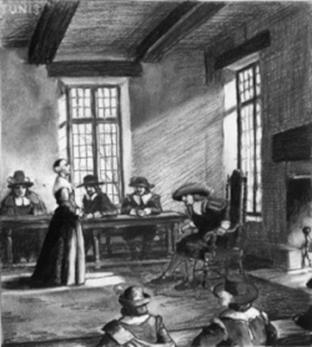
Margaret Brent Before the Maryland Assembly (Tunis, 1934)
Margaret Brent
“I’ve come to seek a voice in this assembly. And yet because I am
a woman, forsooth I must stand idly by and not even have a voice
in the framing of your laws.”
Margaret Brent sailed to Maryland in 1638, and became the first female land owner in the colony in 1639. She was an ally of Leonard Calvert, Governor of the Maryland Colony. When he dies in 1645, he named her executrix of his estate. She used her position to defuse a potential crisis. Calvert had hired mercenaries to defend Maryland against raiders from Virginia (the English Civil War having spilled over to the colonies), but died before he had paid them. His dying instructions to Brent were “take all, spend all”. Brent sold his property to pay the mercenaries and feed the colonists, preventing civil strife. Representing the estate’s interest, she was the first woman to argue in court and attempted to take part in the Assembly. Calvert’s brother was unhappy that she had spent the inheritance, and when he became Governor, forced her to move to Virginia.
Our quote today was Brent’s response when the Assembly refused to allow her to take part in their deliberations. At that time, the only women allowed to take part in the Assembly were Queens. Sometimes attitudes take a while to change! We can count ourselves fortunate that today all people are able to “have a voice” in the USA. Let’s keep it that way, and not silence voices for any reason.
Virginia Reed was a member of the ill-fated Donner (or Donner-Reed) Party at the age of 13. Her stepfather was banished from the party after killing one of the hired teamsters in a fight over treatment of the oxen. He was sent away unarmed, but Virginia rode ahead on her pony and provided him with a rifle and food. He made it over the mountains to Sutter’s Fort before the snow fell and was the leader of the rescue of the Donner Party from the West. Later in life, Virginia married John Murphy and was a successful businesswoman in San Jose.
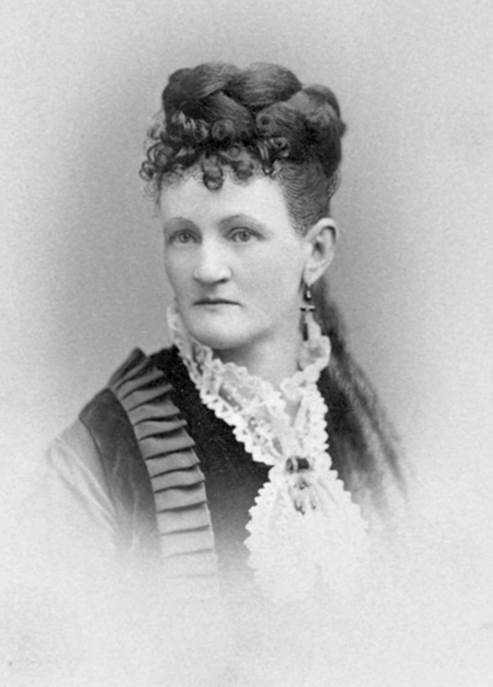
Virginia Reed Murphy in later life
Virginia Reed
“Don’t let this letter dishearten anybody and never take no
cutoffs and hurry along as fast as you can.”
Today’s quote from Virginia Reed is not from her memoirs, but from a letter she wrote after recovering in California. In it she exhorted her family and friends to come and join her – but warning them “never take no cutoffs” – a mistake her party had made was taking a cutoff or short cut, thinking to hasten the Donner Party travels. Instead it took them across barren desert and slowed their progress. From this distance we see a certain irony in her words, but we should be careful of short cuts and half-measures in the name of expediency. Doing things right the first time is often the fastest and surest way.
Mary Ellen Pleasant had an unsettled childhood. Her place of birth and her original surname are unknown. Her mother abandoned her at a very early age, and she lived with a couple named Williams, but was eventually brought to Nantucket to be an indentured servant to the Hussey-Gardner family. Working in their store, she learned how to run a business, and was treated as an equal by these avowed abolitionists. This served as a springboard to her great business success and fights against segregation.
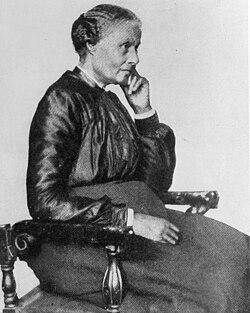
Mary Ellen Pleasant, circa 1901
Mary Ellen Pleasant
“I’d rather be a corpse than a coward”
Mary Ellen Pleasant was born in 1814 – she never knew exactly where. Abandoned by her mother at a young age, she was raised by family of abolitionist Quakers on Nantucket, who had a store that catered to the whaling business. Although first brought to their home as a servant, they came to consider her a member of the family and she learned by practice the principles of business. In her 20’s she moved to Boston and was part of the Underground Railroad. Her first husband died after a short marriage, and she then married John Pleasant, a former slave. In 1849 she moved to California as part of the Gold Rush. While her husband worked as a cook on ocean going vessels, Mary invested her money and made more, while she also worked all kinds of jobs. She secretly used her wealth to fund John Brown’s raid on Harper’s Ferry. After the war she continued to work and invest shrewdly – she was worth 30 million dollars in 1875, the equivalent of a billionaire today. She used her money to fight segregation in California and for other causes. She died in 1904, at the age of 89, the first great African-American female entrepreneur.
Our quote from Mrs. Pleasant exudes the kind of bravery that kept the United States going for these 250 years. Given the choice, she would rather die than be a coward. She had her convictions and she stood up for them. Let us do the same.
These are the three of the women we quote from this month in our book of quotes for the American semiquincentennial in 2026. From the 1600s to the 1900s, they worked to build this country. You can find more here:
Purchase on Amazon: https://www.amazon.com/Discovering-America-Again-Quotations-Explorers/dp/B0GCZ7RCDB/

 Discovering America Again
Leave a comment