William P Duncan
This month of February we happen to quote some “Men of God” who were part of the early exploration of the USA. There is Thomas Hooker, leader of the Connecticut Colony; Roger Williams, exiled from Massachusetts to found Rhode Island; and James Oglethorpe, who founded Georgia as a way for people to escape Debtors Prison.
Purchase the book here on Amazon:
https://www.amazon.com/Discovering-America-Again-Quotations-Explorers/dp/B0GCZ7RCDB/
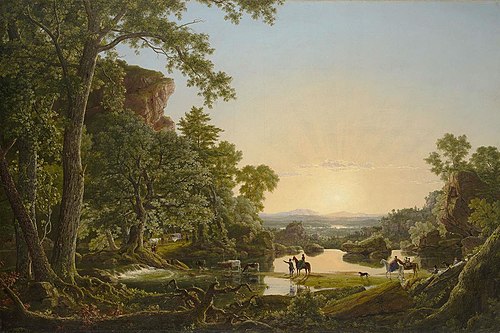
Thomas Hooker and company travel from Plymouth to Hartford
Thomas Hooker
“The will of man is uncontrollable, it will stand out against all reasons and arguments, and nothing can move the will except God work upon it.”
Thomas Hooker was one of the Puritan ministers who came to the Massachusetts Colony, founded in 1630. Hooker disagreed with the Puritan leaders over suffrage – he did not want to limit voting to members of the Puritan church. So he took a group of colonists to found a new colony – Connecticut. The founding document of the colony the “Fundamental Orders of Connecticut” is considered to be the first written constitution for a democratic government, and the ancestor to the United States Constitution.
Our quote today is from Hooker. Although he advocated for all (or at least all men) to have a vote, he recognized that people are not innately good. People will do what they want, they will not listen to reason or arguments. To move the country and the culture, God must work on the will of all people. So let us pray for that.
Hooker’s contribution to the development of constitutional democracy is not sufficiently recognized!
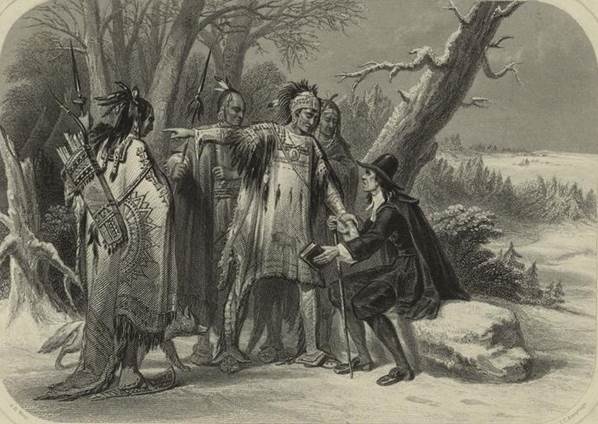
Roger Williams meeting with the Narragansett
Roger Williams
“But who is to decide who truly fears the Lord? The magistrate has no power to enforce religious demands. The laws of the First Table of the Ten Commandments are not regulations for a civil society or a political order. They belong to the realm of religion, not politics.”
A little background on what Williams is saying here. The Ten Commandments are sometimes broken in two: the First Table is commandments 1-5, and the Second Table is 6-10, based on the idea that Moses inscribed them on two stone tablets in that way. The First Table then are the religious commandments: no other gods, no idols, no cursing, keep the Sabbath, honor your parents. It is these that Williams suggests are not for a secular government to enforce. The Second Table includes commandments that are part of regulating civil society: do not kill, do not steal, no false witness (in our modern times, adultery and covetousness are placed more with the first 5, but this was not always so).
What we will focus on is that first line: “who is to decide?” When government starts to regulate thought and speech rather than punishing evil actions, who is to decide? Our hyper-connected age has shown how some people are still longing to control and punish speech and thought that they disagree with. Let us keep the model of Roger Williams in mind, and in this 250th year, keep America free for all to worship and believe as they choose.
Roger Williams disagreed -at least in part – with the way the Puritan church ran the Massachusetts colony, including advocating for friendlier relations with the Natives. For being a dissenter, he was forced to leave the colony, and with a few likeminded souls, founded Rhode Island.
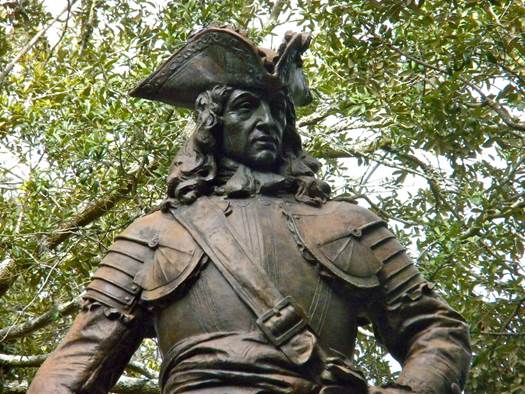
Statue of Oglethorpe in Savannah GA
James Edward Oglethorpe
“If We allow Slaves, we act against the very Principles by which we associated together, which was to relieve the distressed.”
James Edward Oglethorpe founded Georgia. He had been appointed to a committee investigating English jails (or gaols, to use their spelling), and found the practice of jailing people for indebtedness counter-productive. He then proposed instead to bring them to America to start anew. He brought 100 or so of these debtors over in 1732 to start Georgia. He was the leader of the colony until 1743, when he returned to England. As an elderly man, Oglethorpe attempted to convince the English government to accede to the colonists demands of full citizenship and rights, but he was not successful. We can only imagine what would have happened if they had listened!
In today’s quote, Oglethorpe speaks out against slavery. While he was leader of Georgia, slavery was banned in the colony. In his later years, after returning to England, he was part of the early abolitionist movement there. Slavery is an ancient practice – it is attested to in ancient Egypt and Sumeria, and probably existed 10,000 years ago. It was accepted as a fact of life up into the 1700s, when men such as Oglethorpe identified it as evil and began the long (and still incomplete) task of ridding the world of slavery. In this month, when we recognize African-American history, which is so bound up with slavery, we also recognize that from the beginning of America, there were those who opposed it and worked to eradicate it.
Oglethorpe was not an ordained minister, more of a philosopher, but advocated for important advances in morality and society. He fought against the injustices of debtors prisons and slavery, and had his advice been followed, we might still be British colonies!
These three men all contributed to the founding of the United States in the late 1600s and early 1700s, and helped to se the course it would follow: constitutional democracy, freedom, and tolerance.
Purchase on Amazon: https://www.amazon.com/Discovering-America-Again-Quotations-Explorers/dp/B0GCZ7RCDB/

 Discovering America Again
Leave a comment